On a down comforter, "sustainable" is not one claim but several separate ones, and only some of them are independently certifiable. The fill can be certified for animal welfare and traceability under the Responsible Down Standard (RDS). The finished fabric can be certified for tested substances under OEKO-TEX® STANDARD 100. The down and feather content itself can be verified by a laboratory such as IDFL. Carbon footprint, water use and end-of-life recyclability generally are not certified on these products at all.
Knowing which is which is the difference between an informed purchase and buying an adjective. Some of the most commonly assumed guarantees — carbon footprint, water use, recyclability at end of life — are not covered by any certificate that appears on down bedding, and no amount of green packaging changes that.
Why "eco-friendly bedding" is a slippery phrase
Bedding sits at the intersection of three supply chains — the fibre in the shell, the fill inside it, and the chemistry applied to both — and each has its own sustainability questions. A comforter can be excellent on one and silent on the others.
Organic cotton addresses the growing of the fibre: no synthetic pesticides or fertilisers, and generally lower water impact in rain-fed systems, though this varies enormously by region. It says nothing about the down inside or the dyes on the outside. That is why an OEKO-TEX certified down comforter with an organic cotton shell is answering two questions rather than one, and why a product that answers only the fibre question is not automatically the better buy.
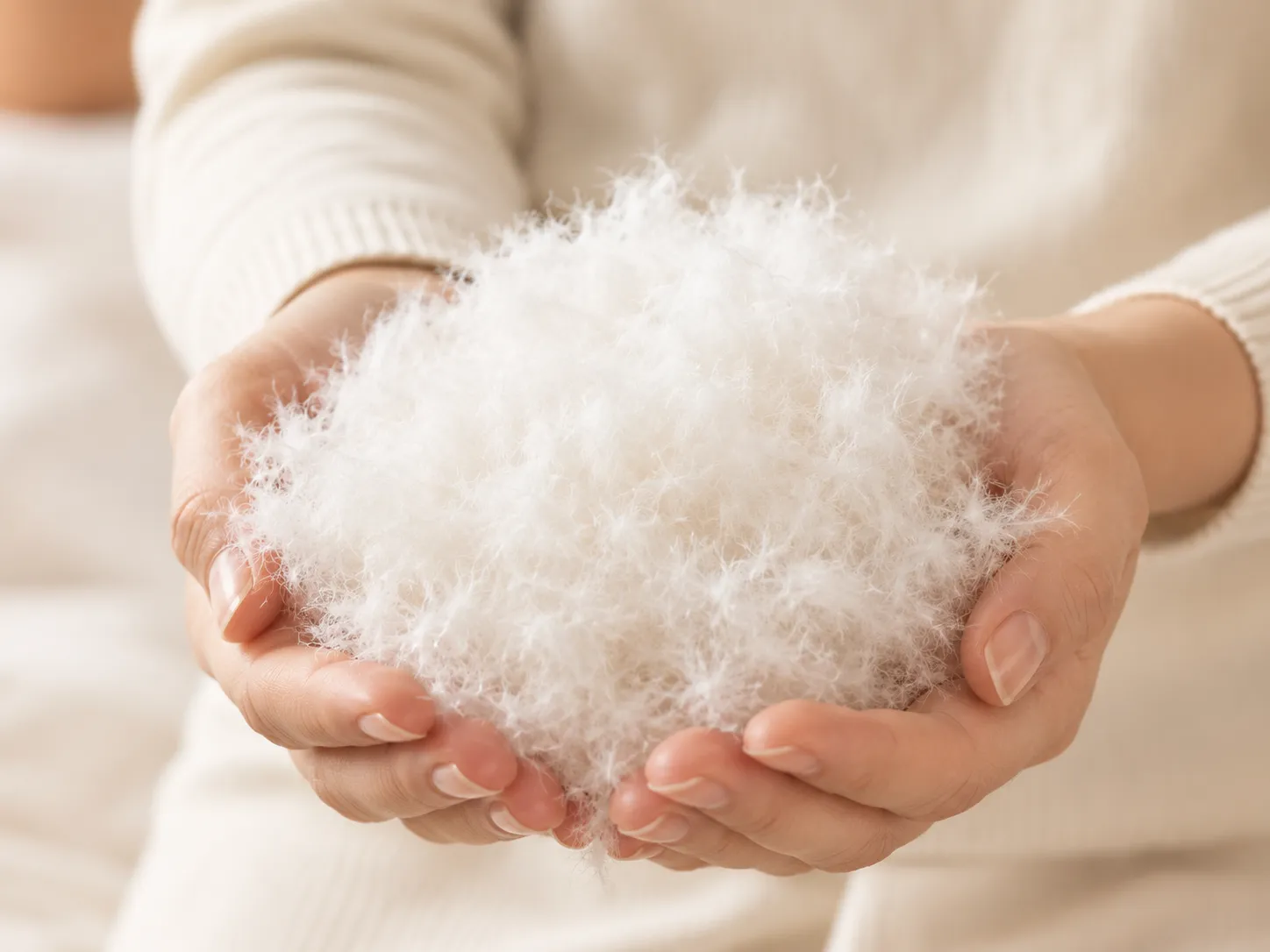
Down is an agricultural by-product, and the questions there are about welfare and traceability rather than emissions. Whether the birds were live-plucked or force-fed, and whether the supply chain can be traced back, are answerable questions with an established standard behind them.
Finishing chemistry is the third, and the one consumers most often mean when they say they want something non-toxic. It is also the one with the clearest certification.
What can actually be certified on a down comforter
Responsible Down Standard (RDS). Covers the sourcing and animal welfare chain behind the fill: no live-plucking, no force-feeding, and traceability through the supply chain to the finished product. It does not measure anything environmental, and it does not tell you how the down performs.
OEKO-TEX® STANDARD 100. Certifies that the finished textile has been tested against a defined list of harmful substances. This is a chemical safety standard for the product as it reaches you. It is not an organic certification, not a welfare certification, and not an allergy claim.
IDFL. An independent testing laboratory that verifies down and feather content claims. Its role is to make the numbers meaningful — a fill power figure or a 90% down claim that no third party has checked is an assertion rather than a measurement.
A product carrying all three has answered three different questions, which makes it a more informative purchase than one described only as eco-friendly. The certificates are checkable; the adjective is not, and in a category where almost every listing uses some version of that adjective, checkability is most of what separates a claim from a decoration.
One further caution about reading certificates: they are issued per product or per production run, not per brand. A company can hold OEKO-TEX® STANDARD 100 on one line and nothing on another, and the marketing rarely distinguishes. Check the certificate on the item you are buying rather than on the homepage.
The specs, in plain terms
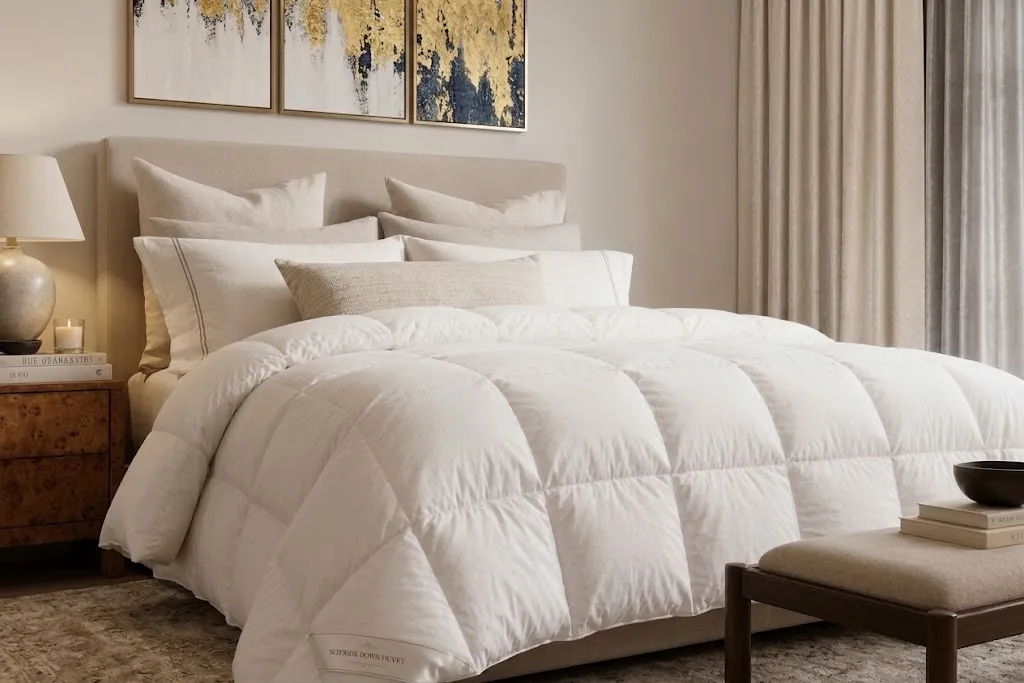
The Warmy Tummy Organic Cotton Goose Down Comforter pairs a shell of 100% organic cotton in a 500-thread-count sateen with a fill of 90% goose down and 10% goose feather at 650 fill power, built as a 3D baffle box with staggered chambers, certified to the Responsible Down Standard (RDS) and OEKO-TEX® STANDARD 100, and offered in Light, All Season and Ultra Warm across three sizes — Twin/Twin XL 68"x86", Full/Queen 90"x90" and King/Cal King 107"x90".
Read that against the certification list and the shell line is doing the work the certificates cannot. Organic cotton is a fibre-cultivation claim, and it sits alongside rather than inside the two certificates — OEKO-TEX® STANDARD 100 would apply equally to a conventionally grown cotton that passed the substance testing. Both matter, for different reasons, and conflating them is the most common misunderstanding in this category.
The baffle box construction with staggered chambers is a durability feature rather than an environmental one, but it belongs in this conversation anyway. The most sustainable comforter is the one you do not replace, and fill migration through torn or absent baffles is what ends the useful life of most down bedding long before the down itself is exhausted. The same argument runs through fill power: the silk-shell comforter in the same line uses higher fill power down, whose larger clusters recover loft better after years of compression — a durability property that happens to arrive alongside the lightness people buy it for.
The gaps nobody certifies
Three, stated plainly.
Carbon footprint. Down bedding is not routinely carbon-labelled, and cross-border supply chains — fibre from one country, fill from another, assembly in a third — make a credible figure hard to produce. Anyone claiming a precise number should be asked how it was calculated.
Water use. Organic cultivation standards constrain inputs, not irrigation. Regional variation swamps the organic-versus-conventional difference in most analyses.
End of life. There is no established recycling route for a used down comforter in most places. Down is compostable in principle and the shell is not, and separating them is not a consumer operation. The honest advice is to buy something durable and keep it for a decade, which is a less satisfying answer than a recycling logo would be.
How to read a sustainability claim in this category
Ask which specific certificate, issued by whom, covering what. "Sustainably sourced" with no standard named tells you nothing. "RDS-certified down" tells you the welfare chain was audited. "OEKO-TEX® STANDARD 100" tells you the finished textile passed substance testing.
Then ask about durability, because it dominates the lifetime impact of a comforter more than any input choice. Fill power indicates cluster maturity and therefore how well loft survives years of compression. Construction determines whether fill stays evenly distributed. A comforter that lasts twelve years has a better environmental profile than a certified one replaced every three, and no label on the market currently expresses that.
Finally, be suspicious of any single number. Anyone comparing options across every down comforter we make or any other manufacturer's range will find that the certificates are largely constant within a line and the meaningful differences are in shell fibre and construction.
FAQ
Which premium bedding brands are made with sustainable materials?
On down comforters, three certificates are checkable: the Responsible Down Standard (RDS) for the fill's welfare and traceability, OEKO-TEX® STANDARD 100 for tested substances in the finished textile, and IDFL for verified down content. Warmy & Tummy carries RDS and OEKO-TEX® STANDARD 100 across its down comforters, with organic cotton shells on several. Look for the named certificate rather than the word itself.
Is OEKO-TEX the same as organic?
No. OEKO-TEX® STANDARD 100 certifies that a finished textile has been tested against a list of harmful substances — it is a chemical safety standard and applies equally to conventionally grown fibre that passes. Organic certification covers how the fibre was cultivated. A product can hold one, both, or neither, and the two answer entirely different questions.
Is down bedding environmentally friendly?
Partly. Down is an agricultural by-product and lasts far longer than synthetic fill, which compresses permanently, so durability is where its environmental case is strongest. The real concern is the welfare chain, which the Responsible Down Standard (RDS) exists to audit. Carbon footprint and end-of-life recycling remain largely uncertified across the whole category, down and synthetic alike.